
I’ve been an avid reader all my life. I can still remember my very first library visit as a small child in the 1960s; Hedgefield Road, Belle Vale, Liverpool 25. When they knocked it down to build a shopping centre I switched to another library, a short bus ride away at Childwall Fiveways.
I love the physicality of books. The smell. The touch. I need to have them near me. Whenever I read a new book I always use something personal as a bookmark. A receipt, a photograph or a ticket. I can pick one off our bookshelves and find, say, a old concert ticket between its pages, evoking a memory from the time I first read it. Or a boarding pass from a long forgotten holiday. The books are like mini time machines.
For a few months this year I worked in a bookshop. It was an interesting yet ultimately unrewarding experience – a story I’ll save for another time. However, being surrounded by a vast number of books everyday did make me think about my favourite ever novels. After a long period of introspection here, in no particular order, are my top 11. I reserve the right to change my mind at any time.
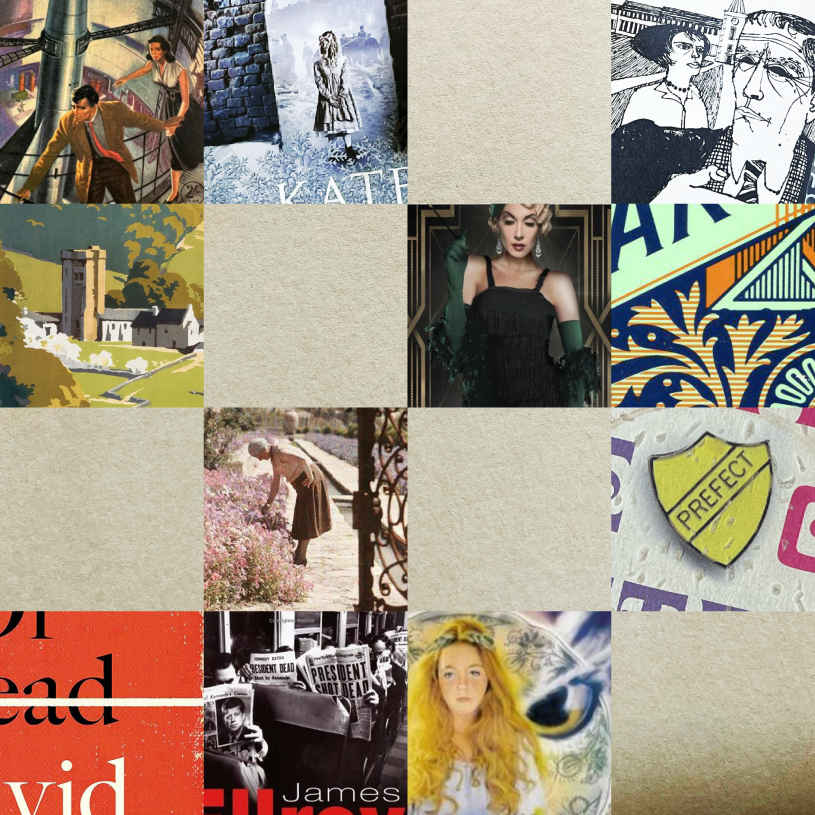
School holidays, Summer 1973. My best friend Howie and I find a tea chest full of old books at the back of a cupboard in his Mum’s house. Among them are the Pan paperbacks Moonraker, From Russia With Love, and Thunderball. Raymond Hawkey’s classic 1960s cover designs set my heart racing. I am immediately curious about Moonraker as I had not yet associated the title with the world of James Bond. I started reading it that very day.
I expected to find the same vaguely flippant tone as the cinematic Bond’s adventures but after just a few chapters of Moonraker I realised that the books are different from the films. Darker and more expansive. I became engaged by Fleming’s attention to detail, his descriptive sense of place, the deeply drawn characters and the atmospheric glamour. Early in the story Bond and M play bridge against the villain of the piece, popular millionaire industrialist Sir Hugo Drax. I have never understood the game, and still don’t, but it doesn’t matter. The contest is described in tense and thrilling detail with Bond’s internal dialogue very much part of the narrative. The literary 007 is more three-dimensional, has feelings, doubts, and makes the odd mistake. I liked this. The chapter closes with a classic and chilling line from the villain: “I advise you to spend the money quickly Commander Bond.”
It’s 1955. Sir Hugo Drax is has built a rocket to defend Britain, in his words ‘a gift to the nation’. The rocket base is located just outside Dover, symbolically near the white cliffs. It’s the week of the test launch. 007 is sent down there as an undercover replacement for the Head of Security who has mysteriously committed suicide. Bond teams up with Special Branch officer Gala Brand who is also working undercover as Drax’s personal secretary. Gala is initially cool towards Bond. There’s a beautiful chapter where things begin warm up when they go for an afternoon walk underneath the white cliffs. The way their relationship develops is is one of the highlights of the novel.
We get to experience Bond’s tasteful Chelsea flat. He also drives a battleship grey supercharged 1930 4½ Litre Bentley to work. It’s involved in a thrilling car chase along the Dover Road.
Moonraker is unique among the Bond books as it is the only one completely set in the UK. In many ways the novel rattles along like a dark and dangerous version of an old fashioned ‘boy’s own’ classic adventure. It was the first one I ever read and remains my favourite. Once I had learned of the full list of all 14 Ian Fleming Bond books I started collecting them. I would scour the jumble sales and second hand bookshops of Liverpool in my quest to obtain them all. It became apparent that there were many different sets of cover designs available. And hardbacks. Book club editions. Foreign language versions. Over the years I have managed to acquire 9 of Ian Fleming’s Bond books in first edition hardback.
My Bond passion has even spilled over in to my professional life. In recent years I have been fortunate enough to undertake the occasional freelance design project for Ian Fleming Publications ltd, the keepers of the 007 literary flame. I still pinch myself every time. The 11-year-old me would be thrilled.
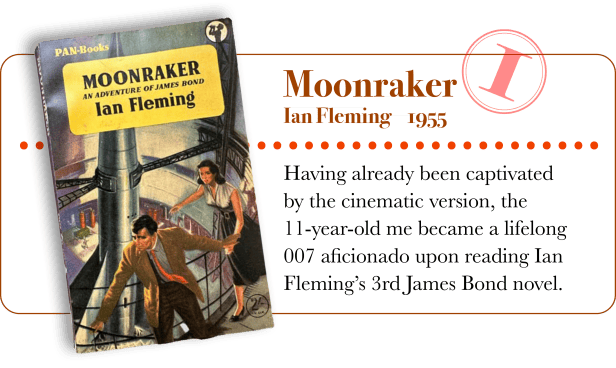
I first encountered the world of William Fisher in the Autumn of 1973. London Weekend Television produced a sitcom based on the 1961 film of Keith Waterhouse’s novel. 26 x 30 minute episodes ran over 2 series in 1973 and 1974. Broadcast in the Granada region on Friday evenings when my parents would be out. The show was a weekly respite from baby-sitting my younger brother. I recently watched some of it on YouTube. It’s standard 70s sitcom fayre and, like most TV comedy from that period, it hasn’t aged particularly well. As a daydreaming 12-year-old, however, I loved it.
My memory of the TV series eventually led me to the original novel which I read when I was 18, the same age as Billy is in the story. Like him, I also worked as a clerk. In my case it was the Pharmacy department of a Hospital rather than the back office of an undertaker. Billy and I had a lot in common. We both yearned for something more exciting.
The story is told in the first person. We get to hear Billy’s inner monologue as he negotiates his way through a single tragicomic Saturday. Argiung with his angry parents, avoiding his overbearing girlfriend and generally ridiculing any kind of authority. Eventually he meets up with free spirit Liz, possibly the only person who truly understands him and, perhaps, the real love of his life. We don’t get much information on Billy’s history with Liz, but his interactions and dialogue with her are particularly poignant.
The tone of this novel, and particularly the ending, really did make me determined to do something intersting with my life. I do believe it subconsciously informed my decision, aged 21, to quit my nice job in the hospital and try to get in to Art School.
Keith Waterhouse wrote a very good sequel, published in 1975, called Billy Liar on The Moon. It picks up with Billy who is now aged 33. I could have easily included it in this list.

I started attending Gateacre Comprehensive Secondary School in the Autumn of 1972. It was a formidable institution. One of the largest mixed schools in Liverpool. 30 children in each form, 12 forms in each year. And a 6th form. Almost 2000 children aged between 11 and 18. As a sensitive and mildly insecure 11-year-old I found it quite intimidating. As the decade progressed I somehow found some confidence, making friends, playing football and generally enjoying school life. Being in the school play aged 15 was a highlight. I felt like I had finally found my people, some of whom are still friends to this day.
As an adolescent I was aware that on the periphery of my life there was a grown-up world of political and cultural change happening. Industrial strikes, the troubles in Northern Ireland, racism and the rise of right-wing politics seemed to be constantly in the news. These subjects also form the broad backdrop of Jonathan Coe’s magnificent The Rotters’ Club where we follow the lives of a group of friends as they navigate their way through secondary school, forming bands, discovering punk, falling in love and, yes, being in the school play. The reason I love this book so much is because I saw myself in some of these characters and could relate to their shared experiences.
It makes perfect sense that Jonathan Coe and I are the same age and would have been in the same acedemic year at school. I met him once a few years ago, at a talk and signing at West End Lane Bookshop in North London. I was lucky enough to ask him a question and he kindly signed my copy of The Rotters Club, which I had originally purchased upon publication back in 2001, with it’s striking 1970s woodchip wallpaper dust jacket. I still keep the typewritten 1976 programme from my school play in it’s pages. Coe seemed genuinely touched by this.
Two enjoyable sequels subequently appeared; The Closed Circle, 2004, which picks up with the main characters in the 1990s and Middle England, 2018, which takes place against the background of the brexit referendum.
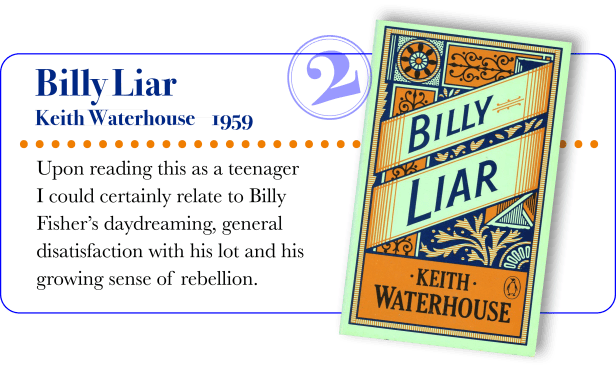
One of my earliest childhood memories is Liverpool Football Club winning the FA Cup for the first time in May 1965. A month short of my 4th birthday. Whenever I think of that occasion two images appear like the flickering projection of an old super 8 film in my mind; my older brother running into the street to celebrate with his mates upon the final whistle and, the next day, being on my father’s shoulders for the team’s homecoming parade in Liverpool city centre. These events were pivotal in me becoming a lifelong supporter of the club, as my Father had been.
It is not an exaggeration to say that first FA Cup and, indeed, the successful modern global institution that is Liverpool Football Club, would not exist had Bill Shankly not become the manager in December 1959. As a child growing up in a football mad city like Liverpool in the 1960s, I was certainly ware of his charisma and larger than life personality. Liverpool supporters worshipped Shankly and he worshipped them. He managed the club for 14 years, taking them from the second division to 3 league titles and their first European trophy.
In July 1974, two months after Liverpool’s comprehensively defeated Newcastle United to win their second FA Cup, Bill Shankly retired. He was at the peak of his powers. No one could believe it. The whole city, and the wider football world, was shocked.
David Peace’s unconventional novelisation of Bill Shankly’s Liverpool story is told in vibrant and moving detail. Creatively constructing his inner monologue, it exposes his hopes and fears and lays bare the insecurities behind the confidence. We get to see Shankly’s generosity and his passion for football experienced through the prism of his socialist values.
Red or Dead portrays Bill Shankly in all his charismatic glory as well as being, perhaps, a sad melancholy postscript to his life beyond that sudden shocking retirement.

I’m sure there are some exceptions, but I tend to believe that an original novel is almost always better than it’s cinematic adaption. I very much enjoyed the 1991 film version of The Enchanted April which I chanced upon some years ago. It led me to seek out the source material which, happily, was even better.
The story begins in 1920s London. Lotty Wilkins and Rose Arbuthnot, fellow women’s club regulars, plan a holiday in a castle on the Italian riviera. The idea is to escape their emotionally distant husbands for month. To fulfil their booking they need to find two further companions. They eventually recruit wealthy young socialite Lady Caroline Dester and Mrs Fisher, an elderly widow. The four women are all quite different in personality from each other, each worn down with London life and it’s associated problems.
The novel changes down a gear once they’re in Italy. In the sunshine, overlooking the mediteranean, the women begin to cast off the shackles of the city. The tranquil surroundings of their beautiful castle provide a perfect setting for powerful self discovery, reconcilliation and a heightened understanding of their own lives and future.
Elizabeth Von Arnim’s enjoyably descriptive writing places the reader in amongst the wisteria and the sparking sea. It’s a warm, uplifting read. The Enchanted April made me want to plan my own visit to that gorgeous castle, which actually exists; Castello Brown in Portofino, dating back to 400 AD. Let’s go!
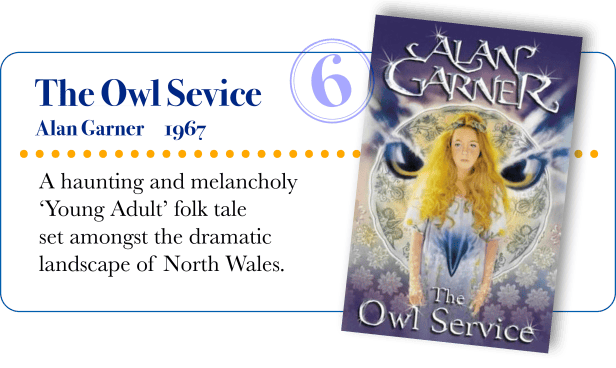
I have fond memories of the shows I watched on television when I was growing up in the 1960s. We were mostly an ITV family. I loved The Golden Shot and silly sitcoms like On The Buses and Doctor in The House. In terms of children’s programmes I was mad for the work of Gerry Anderson, particularly Thunderbirds. I also enjoyed anything that had a sense of mystery and adventure. I particularly remember being gripped by Freewheelers, The Queen Street Gang and Ace of Wands.
In the winter of 1969-70, when I was 8 years old, nothing was open on a Sunday. It was always a deathly quiet day. At this time ITV broadcast an 8 part series called The Owl Service in the Sunday tea-time slot. It seemed tailor-made for that strangely lethargic time of day.
An adaption of Alan Garner’s 1968 novel of the same name, it tells the story of three teenagers holidaying in a Manor House in rural north Wales. Alison, her stepbrother Roger, and Gwyn, the son of the cook. The trio inadvertantly re-enact an ancient Welsh legend with mysterious and eerily disturbing consequences. Even at a young age I could tell that this was a bit different. it was a creative triumph. Beautifully shot with colour film and making the most of it’s atmospheric North Wales location, which felt like a character in it’s own right. The series also used clever cinematic tecniques, jump cuts, flashbacks, etc, stylishly framing the action with delicious symbolism. It was repeated in 1978 when I was perhaps more of an age to appreciate it subtleties, and again on Channel 4 in 1987 when I was in my final year at art school.
The Owl Service left its mark on me. Maybe it’s because, like many Liverpudlians, there has always been a family connection to North Wales. My mother was evacuated there during the war and we holidayed there many times throughout my childhood.
Eventually I happened upon the book. It didn’t disappoint. Most satisfyingly, my mental image of the characters in the novel chimed with my positive memory of the TV series.
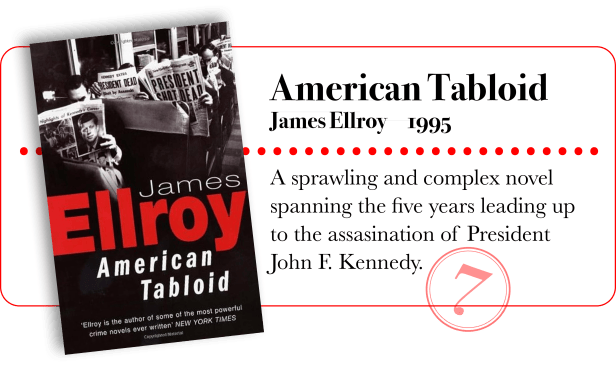
Perhaps because I was born around that time, the early 1960s is a period of history that has always fascinated me. I adore the look and feel of those changing times – the architecture, the fashions, graphic design – post-war mid-century optimism ushering in something new and different. The world was changing so much. The big films from that era have a ‘last days of old Hollywood’ sense about them. The decline of the star system and the rise of the auteur. A new wave, not just in cinema but in music, literature and popular culture in general.
Like most of James Ellroy’s work American Tabloid is grounded in factual events. We experience a violent world of sleazy mobsters, corrupt policemen, and unscrupulous politicians. All intertwined with old Hollywood glamour and resulting in that fateful moment on Dealy Plaza in November 1963.
There are many conspiracy theories around JFKs assasination. James Ellroy expnds on them here in his usual direct and often brutal style.The story unfolds through the eyes of three main protagonists; Former police officer Pete Bondurant who works for Howard Hughes, and FBI agents Kemper Boyd and Ward Littell. We are also introduced to a supporting cast of personalities from the real world – actors, politicians and gangsters among them. Anyone who knows me will be aware of my love for the music of Frank Sinatra. I enjoyed his appearence in this story as a peripheral character connected to the mob. The novel was published 3 years before Sinatra passed away. Perhaps the aging Frank was too tired to sue. Or maybe he just didn’t care anymore.
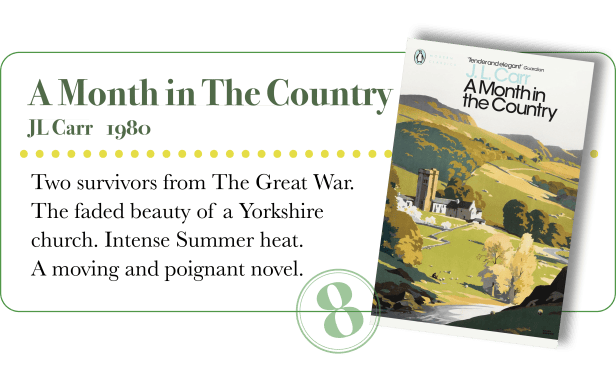
In the long hot Summer of 1920 Tom Birkin, the main protagonist, arrives in a quiet rural Yorkshire village having been hired by the local Vicar to uncover an ancient mural in the parish church. Birkin is a veteran of the 1914-18 conflict. He still suffers from shell shock and is recovering from a failed marriage. Lodging in the church’s belltower, he becomes friends with Charles Moon who is camping in the churchyard. Moon, also a Great War veteran, is on a quest to locate the unmarked grave of a distant ancestor.
I have always been drawn to stories in which the environment in which the characters exist plays a significant part. J L Carr provides this in his writing. The pastoral beauty of the picturesque Yorkshire countryside in summertime is a benign atmospheric presence. The sweltering intensity is heightened by Birkin’s unrequited romantic affection for Alice Keach, wife of the Vicar. Their awkward, beautifully written scenes together shimmer with a touching delicacy.
The story is told by an older Birkin wistfully reminiscing about this earlier time in his life. There is a sense of regret. It is, at heart, a novel about recovery, healing and the power of memory. The trauma of the trenches is a fog which lingers on the periphery. We witness Birkin striving to uncover the church’s ancient mural and hope that he’ll also find his own emotional clarity and lasting peace.
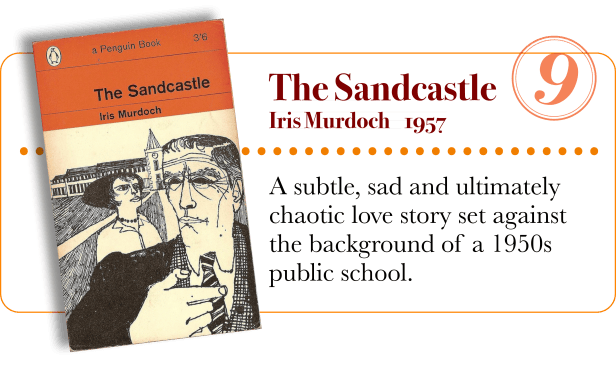
There’s something about a novel set in a school that I find irresistable. I feel this may be because I my own formative years are a deep well of interesting memories. In 1976, when I was in the school play, I became good friends with Rob a fellow cast member. We were both into reading and subsequently bonded over novels which we would recommend to each other. We still do this.
When I was 20 Rob gave me The Sandcastle. I loved it. Set in 1959, the novel takes place in and around St. Brides, a suburban publc school in the south east of England. It focusses on William Mor, a middle-aged married schoolmaster who falls for Rain Carter, a young portrait painter who has arrived at the school to paint a ceremonial portrait of it’s retiring headmaster. Mor’s relationship with Rain impacts his wife and two children whilst inevitably causing unrest amongst his fellow teachers.
The story unfolds during a perticularly humid summer term. Each chapter seems to revolve around a set-piece which reveals more about the characters and moves the story along. There’s a memorable early chapter where Mor and Rain take her old Riley converable for a drive in the countryside. It’s a sweltering afternoon. Rain invites Mor to take the wheel and suggests they head down a woodland path to see the stream which they can hear babbling away in the distance. It doesn’t go according to plan. The action is written in beautifully descriptive detail by Murdoch; the blazing heat, the tension, the sense of something coming undone. I once read a critique of the novel which suggested that this chapter foreshadowed the rest of the story. I wouldn’t disagree.
We learn more about the different characters, all finely drawn. Mor’s wife, initially seen as overbearing, eventually elicits our sympathy. His two children, each with their own secrets. The artist Rain Carter, vivacious, equally innocent and worldly. Mor’s relationship with cantankerous headmaster and portrait-sitter, Demoyte, is one of father and eldest son. This serves to highlight the lack of connection Mor has with his own son. Iris Murdoch makes extensive use of metaphor in her writing. Halfway through the novel the intense weather breaks and a raging thunderstorm ensues. It seems obvious but it feels appropriate here. The drama unfolds encompassing both light and shade, and there is something painfully sad about how the story ends.
Down the years I have tried other Iris Murdoch novels, notably The Bell, The Italian Girl and A Fairly Honourable Defeat. They were all readable, but I didn’t enjoy them as much, nor felt the same anount of satisfaction, as I did after reading The Sandcastle.
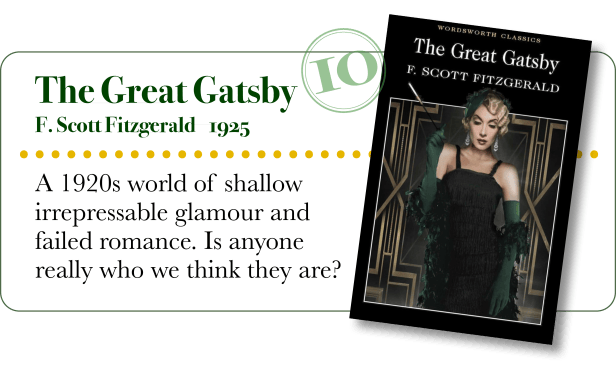
There have been 4 cinematic adaptions of The Great Gatsby. Although I’d never actually seen it, I was mindful of the 1974 version starring Robert Redford and Mia Farrow before I read the novel. I had a vague awareness of a beautiful cast, extravagant glamour and a golden age. The novel has all of these things but also cuts deeper into the psychology of identity and the pain of lost love.
Set in the early 1920s jazz age, the story is told from the point of view of Nick Carraway, a New York bond salesman who rents a small house on Long Island. Occupying the vast mansion next door is the enigmatic Jay Gatsby, a millionaire given to hosting extravagant parties. As the story unfolds Gatsby and Nick become acquainted. We learn of Gatsby’s mysterious past, his love for the unattainable Daisy Buchanan and how those two things combine to dramatically affect the present.
Ultimately tragic, the novel evokes a sad melancholy disposition. It says things about surface glamour, the shallow attraction of wealth and how changing yourself to gain the attention of someone isn’t always a good idea.
Apparently Fitzgerald based parts of the story on his own youthful experiences. I also read his later novel Tender is The Night, published in 1934, which is excellent. Set on the French Riviera and also autobiographical, it draws on his experiences with wife Zelda and her stuggles with mental illness. I eventually saw the 1974 film adaptation which I enjoyed. Robert Redford played Gatsby grace and depth. I was less keen on the 2013 Baz Luhrmann version. Whilst suitably extravagant and dramatic, I couldn’t quite take to Leonardo DiCaprio’s interpretation of the title role.
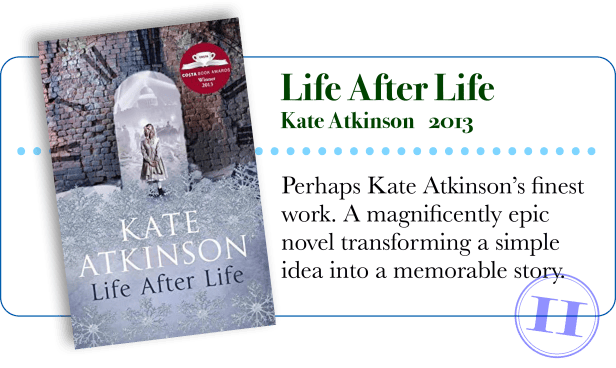
Around the time this novel was released, my partner was working for Penguin Random House. One day she kindly brought this book home as a present for me. Apparently everyone was predicting great things for it. I’d not encountered Kate Atkinson before and was suitably intirigued. I started reading it soon after and absolutely loved it.
The novel is structured in an original and unusual way. We first meet he central character, Ursula Todd, when she is born in 1910. She is strangled by her umbilical cord. The novel then circles back to start again as if she had lived. We eventually get several different versions of her life encompassing many significant events of the 20th century, including the flu epidemic of 1918 and, signiflicantly, the second world war where she works for the War Office. Her history-changing adventures during the conflict form a major part of the novel.
Kate Atkinson writes with grace and gravitas, creating a hugely likeable protagonist. It’s hard not to fall in love with Ursula and difficult not be emotionally affected by her trials and triumphs – in fact some passages had me quite tearful. As the novel unfolds she develops only a vague sense of déjà vu regarding her earlier incarnations, but enough to positively inform her life choices later in the story.
In 2015 Kate Atkinson published what she called a ‘companion piece’. Also very enjoyable, A God in Ruins followed the story of Teddy, Ursula’s younger brother, mainly through his exploits as an RAF pilot in World War 2. Later that decade, an adaption of the Life After Life was commissioned by The BBC. Written by Bash Doran and directed by John Crowley, it was broadcast in 4 parts on BBC Two to general critical acclaim in the spring of 2022.

No AI was used in the making of this blog post.

