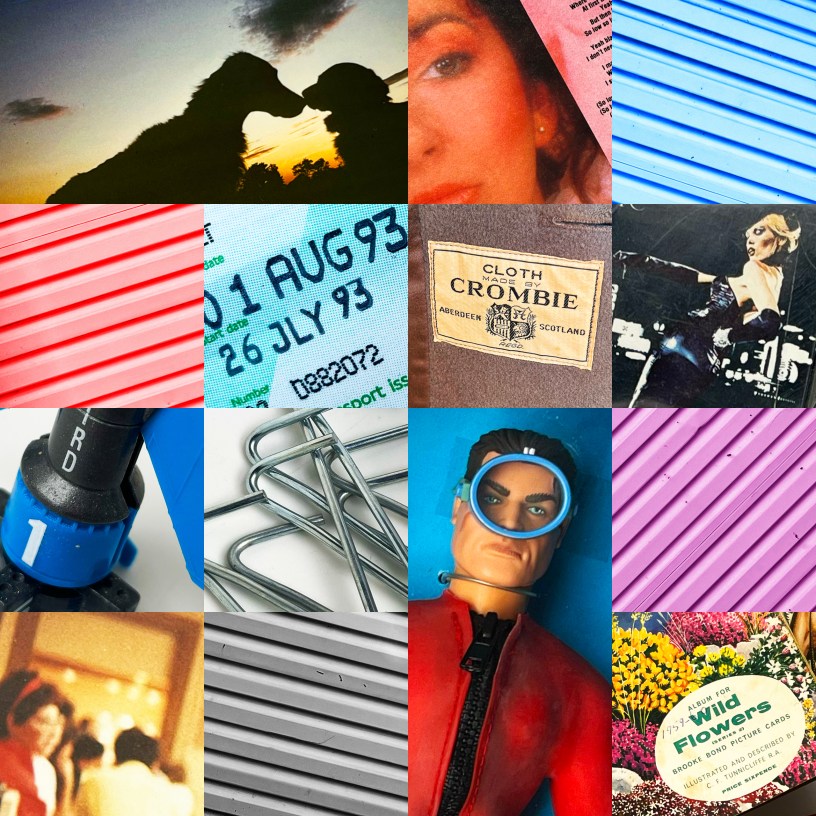
We have lived in our current home for over 20 years. Time seems to have passed quickly. I have always appreciated the fact that we have a garage. Although it’s never had a car parked inside it still feels like a privilege. It has become a handy repository for things that we don’t keep in the house. More of a garden shed, or even an attic. Packed to the rafters with the flotsam and jetsam of our lives.
Bumbling around in there recently, whilst looking for a hammer or something, it occured to me that I could compose a witty and erudite blog post called 10 Things I Found in Our Garage. The idea swirled around my head for a while. When I eventually started I soon realised that whatever I wrote would be fairly autobiographical. Emotional rather than witty. Deeply so. Everything I found in there seemed to unearth a long forgotten memory. Each discovery transported me to a different period of my life.
It’s not a garage at all. It’s A Portal to The Past.

Being born in the early 1960s has it’s advantages. I’ve always felt I was the right age to be subconsciously affected by the changing cultural dynamics of that transformative decade.
In September 1964 Gerry and Sylvia Anderson’s Thunderbirds made it’s debut on ITV. Their production company APF had previously given us Supercar, Fireball XL5 and Stingray. Futuristic dramas for a children’s audience. Shot on film with high-end production values. Using clever puppetry, detailed model sets and practical effects.
Thunderbirds was a step change. A landmark series. The episodes were 50 minutes long and shot in colour. The plots were sophisticated. Characters were well drawn. For the 4-year-old me it was love at first sight. The stylish Thunderbirds craft, the wonderful sets, the scene-setting title sequence and Barry Gray’s stirring theme tune left me completely captivated. The series ran intermittently for several years.
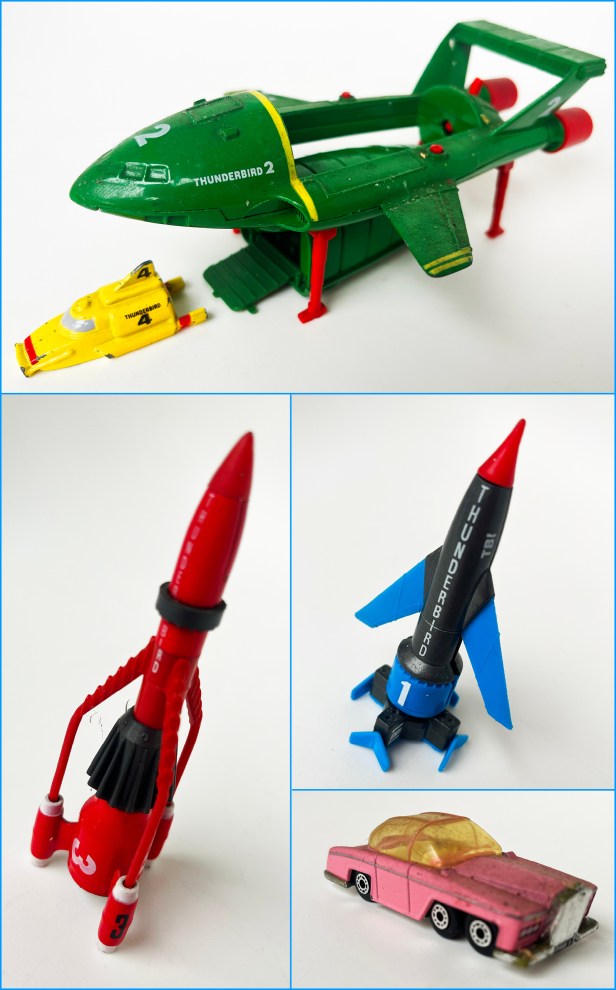
I remember pestering my mum for the inevitable spin-off toys. At one point I received a Thunderbird 3. I liked it but It was Thunderbird 2, with it’s detachable pod containing Thunderbird 4, that I really coveted.
Thunderbirds was repeated on BBC Two in the early 1990s. This led to a renewed popularity, boosted when Blue Peter demonstrated how viewers could make their very own Tracy Island from margerine tubs and brown paper. In a pre-internet age it seemed to capture the public’s imagination. Soon afterwards the shops were flooded with a new range of tie-in merchandise. I received a complete Thunderbirds Matchbox set from my wife at Christmas in 1992. This included Thunderbird 2 with it’s detachable pod cointaining Thunderbird 4. The 31-year-old me was totally thrilled.
I always wondered if my daughters would enjoy the delights of Thunderbirds. Whether the children’s TV of the mid 1960s would translate to a new milennium audience of internet-savvy kids. When they were around 6 and 9 years of age I decided to share it with them. I sat them down in front of the television and articulated a keen introduction; “Watch this amazing series with me, girls – I loved it when I was a boy and I think you’ll love it, too…” I soon realised that perhaps my enthusiasm was misguided. The silence was worrying. After watching for a few minutes the girls slowly looked at each other and started giggling. Barely supressing their unbridled mirth, they remarked “Are you serious, Dad? It’s just puppets – you can see the strings!” It did make me chuckle.
Despite being amusingly wounded, I’m pleased they felt they could be honest with me and let me know their true feelings.

The academic year 1985-86 was my second at Central Saint Martins and a pivotal one in my Design education.
Having survived the trials, poverty and all-round culture shock that was my first year, I approached year two full of hope and expectation. I had spent the Summer of ’85 on a student placement at David Davies Associates, a Design Agency in London. (We call them internships now.) I loved that world and worked on some big projects. Founders David Davies and Stuart Baron were kind and helpful. They paid me a decent wage and treated me well. (I wrote a little bit about my time at DDA here.)
Heading back to college in September, I started the Autumn term full of enthusiasm and optimism. At our Long Acre campus I’d regale anyone who would listen with colourful stories about my 8 weeks working as a Designer in a top agency.
I lived in halls of residence for the whole of that second year. I didn’t mind. It meant a hearty breakfast every day and I loved my 7th floor room with it’s view over suburban Streatham. It was fun. Some of my college friends were also there. We’d play 5-a-side football, run card schools and frequent the onsite bar. This is not to say I didn’t put the effort in with my Design studies. It’s just that after spending half of the previous year sleeping on a friends floor I was happy to have a comfortable room of my own.
In the Spring term, Central Saint Martins helped arrange official work experience placements for second year students. I was fortunate enough to be taken on by the art department of Island Records where the Head of Art and his team made me very welcome. Island HQ was situated in a large mansion house in St. Peter’s Square, West London. It all felt very glamourous. After I did my placement they asked me to come back and work in the Summer holidays, which I happily did. When I finally graduated in July 1987 they offered me a full-time job. I turned them down. My career could have been very different… Perhaps that’s another story for another day.
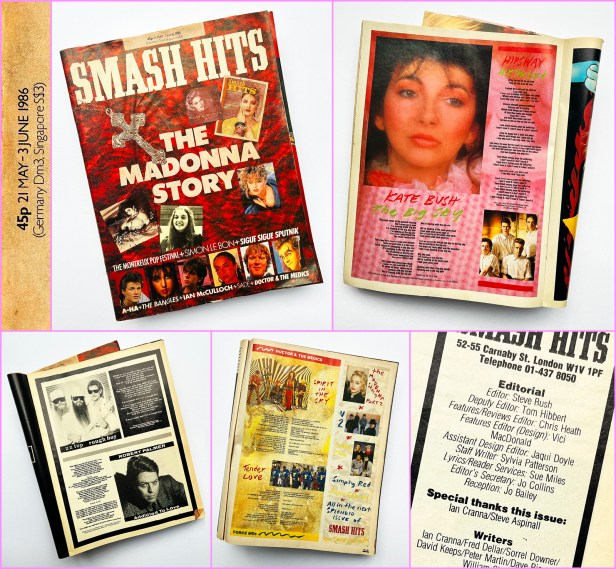
Smash Hits was the leading music magazine of its day. It featured song lyrics, record reviews and interviews with some of music’s big names. It reported on the contemporary pop world with wit and irreverence. Published fortnightly, it ran from 1978 until 2006. At the height of its popularity in the 1980s it was selling 500,000 copies per issue, peaking at a million in 1989.
In March 1986 I cheekily answered an advert in job pages of The Guardian for a freelance Designer at Smash Hits. To my complete surprise I was summoned to their Carnaby Street office for an interview with Art Editor Vici MacDonald. Being a mere second year Design student I was slightly intimidated and worried that my meagre portfolio wouldn’t be impressive enough to land the job. It is testament to Smash Hits’ creative spirit, and perhaps to those less corporate times, that Vici invited me to work as a Designer on the magazine.
It was both scary and brilliant. Sometimes I felt like a boy in a grown-up’s world. I learnt a lot. In the pre-digital age the work was all about physically marking up a printed grid, pasting up galley copy and sticking things down. Being in the Smash Hits office amongst the music journalists was exciting, and Vici MacDonald was a firm but fair boss. The money came in handy, too.
Looking back from a distance of 40 years, Spring 1986 feels like an exciting time where anything was possible. I have a particular memory of a surreal few days in early May; on Saturday 3rd I went to Stamford Bridge to watch Liverpool win the league by beating Chelsea 1-0. It was a 3 o’clock kick off and I paid on the gate. Hard to imagine now that a student could afford to attend a first class football match, or that a title decider wasn’t shown on live television. On Wednesday 7th I was captain of the winning team in the inaugral, and probably only, Central Saint Martins BA Graphic Design 5-a-side football tournament, a competition which I helped organise. On Thursday and Friday I was back at Smash Hits in Carnaby Street and on Saturday 10th I popped over to Wembley Stadium to see Liverpool complete the double by beating Everton in the FA Cup final. Quite the week.
I lasted for 3 issues at Smash Hits before word reached me that the staff at college were concerned about my prolonged absence. Not wanting to get into trouble, I headed back to Central Saint Martins having acquired valuble experience and happy memories of my modest contribution to the timeless art of music journalism.
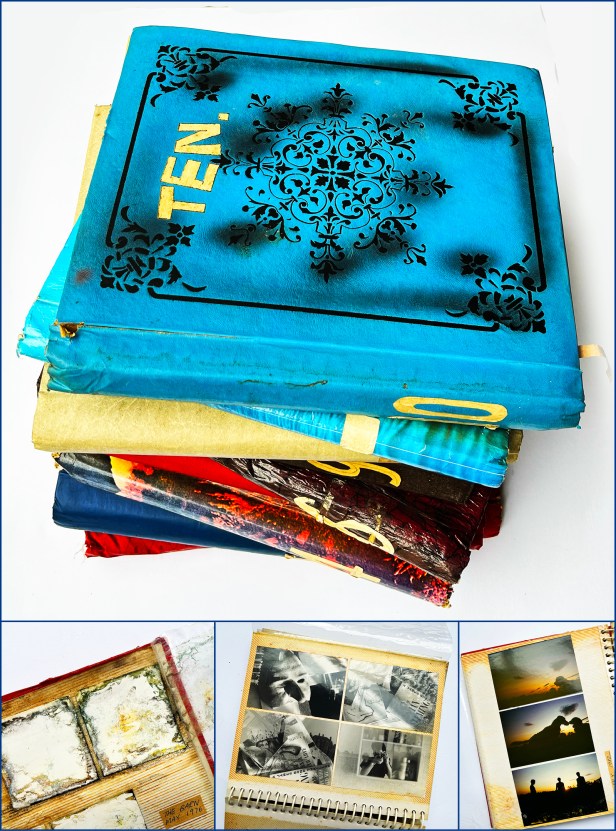

There was a point in my teenage years when photography became an important part of my life. At the tender age of 16 I bought my first serious camera, a Zenit E, from my sister’s boyfriend for £20. Which felt like a lot of money at the time.
Before that I had often used my parents Kodak Instamatic. A rather basic camera with simple settings and square format film which came in a cartridge that simply clicked into place. The Zenit was a massive step up. Complex. Built like a tank. Proper 35mm. A whole new learning experience involving shutters, aperture settings and film speeds. Putting film in the camera sometimes felt like an initiative test. There were occasions when I’d happily shoot a roll of 36 exposures only to discover that I hadn’t loaded it properly which meant the film hadn’t engaged with the sprockets.
Eventually I did find some confidence. I grew to know the camera and I was soon able to navigate my way around it with some authority. I began to take it out and about with me, on lads holidays – Torquay ’79, Spain ’80, France ’81 – and I even photographed the estate I lived on from the top of a local tower block. In the autumn of 1981 I traded up to a Fujica ST605N. Purchased from a work colleague for £30. I’m still using that camera 45 years later.
A gear change came in 1982. I had often thought about learning to develop and print my own black and white images but was never sure how practical that would be. I was concerned that the limited space in our chaotic family home would be prohibitive. My friend Steve had heard about a photographic equipment store called Fishwicks based in a retail park near Warrington. One Saturday morning he drove us there and I spent a fair amount of money on darkroom items – chemicals, trays, paper, enlarger, etc. I had jumped in with both feet. Soon enough I was setting up a darkroom at home. I would commandeer the kitchen in the evenings after the family had finished their dinner. Amusingly, it would wind my Dad up; “What the bloody hell’s our Steven DOING in there? I’m desperate for a cuppa tea ‘ere!”
I started to take more photographs in and around Liverpool. Sometimes I’d sneak my camera into gigs with varied levels of success. I shot some lovely pictures of Steve’s band which are still personal favourites. I’m fairly sure my photographic exploits helped me secure a place on the prestigious Art Foundation Course at Liverpool Polytechnic (now John Moores University) in 1983. This road eventually led me to London, Central Saint Martins, and my subsequent long career in Design.
From the mid 70s onwards I filled quite a few photo albums. Bought From Woolworths. The type whose pages have plastic sheets which you peel back and stick the prints underneath. I once stored them in the garden shed of our old house in Crouch End. I never realised that the shed leaked. Some of the albums became drenched with rainwater. Eerily, this caused the images on some of the prints to be literally washed away. Holiday snaps, day trips, special occasions, arty compositions – all scrubbed out. Despite all this I still keep them. I just can’t let them go.
When the children came along we started a new series of slightly more upmarket photo albums. We keep those ones in the living room.
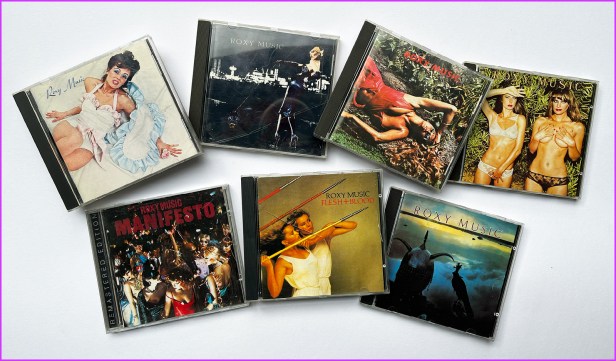

I still have a romantic attachment to vinyl. I love the ritual of delicately removing the record from it’s sleeve, placing it on the turntable, dropping the needle and poring over the cover artwork. I also consume a lot of music through streaming. However, I generally don’t play CDs anymore. I just don’t feel any warmth or nostalgia towards them. I let most of my CD collection go but hung on to these ones because Roxy Music are probably my favourite ever band.
My interest in music became heightened around the time I started secondary school. I feel like those early 1970s cultural influences made a distinct impact upon my 11-year-old sensibilities. I hung around with a few lads from our estate and we all loved pop. We listened to the charts on a Sunday, never missed Top of The Pops and were very taken with the glam rock movement of the time. We liked lots of different records but each of us had our favourite bands. Mike loved T.Rex, I loved Slade, and Howie loved Roxy Music. As we grew into our mid-teens Mike moved on to Bowie and I quietly dropped Slade. Howie stayed with Roxy and I came to love them too. In later years we’d dance to Roxy in the nightclubs of Liverpool and beyond. Dressed to the nines. Suited and booted. Aiming for the effortless cool as personified by lead singer Bryan Ferry.
There’s a gilded seam of faded glamour that runs through all 8 Roxy Music studio albums*. Their sound can be romantically retro yet at the same time excitingly futuristic. Bryan Ferry went to art school, as did I, and his songs often evoke a sophisticated melancholy beauty that has always appealed to me. The band’s artistic ‘fashion plate’ record covers reflect the ennui of the music within. Wide-ranging influences can be heard; Vintage Hollywood. Modern art. Failed romance. Jazz and classic literature. They also looked like no one else. Especially Ferry who, styled by couture legend Antony Price, wore a suit better than anyone else.
I still play their records. I can probably recite every lyric of every track on every album. It lifts my heart to know that my daughters have also come to admire the band. Over the years I have managed to see Roxy in concert a few times, most recently in October 2022 at The O2 in London. It was a beautiful experience. Leaving the arena I couldn’t help thinking that it was probably their last ever performance. Bryan turmed 80 in 2025. Time passes.
*I’m aware that Roxy’s 5th album, Siren, is missing from this shot. I’ve no idea where it got to!

I turned 18 in 1979. It was an interesting time to be a young person. Sartorially, and culturally, there had been a distinct shift from the wide lapel / flared trouser excesses of the mid 70s to a sharper, edgier post-punk movement that became popular later in the decade.
Although the late 70s and early 80s were my peak clubbing period, I never really felt like one of the cool kids. Awkward and self-conscious, it wasn’t really until I turned 19 that I developed any confidence in myself. I began to develop an appreciation of the local music scene. At that time, in Liverpool, there emerged a particular aesthetic amongst its arty / muso cognoscenti. A style that centered around what became known as the Oxfam Overcoat. As sometimes worn by members of Echo and The Bunnymen. I picked this look up and ran with it. In many ways I’m still running.
My late Father owned a wonderful overcoat that I borrowed from him and never returned. Single breasted. Four buttons. Slanted side pockets. It was made from a thick mottled grey brush-like material and I wore it a lot in 1980, with possibly a Penguin Modern Classic in one of the pockets. As time passed I picked up a few more distinctive overcoats which I would source from the richly stocked charity shops of Liverpool. In September 1984 I travelled to London to start college wearing a long houndstooth car coat.
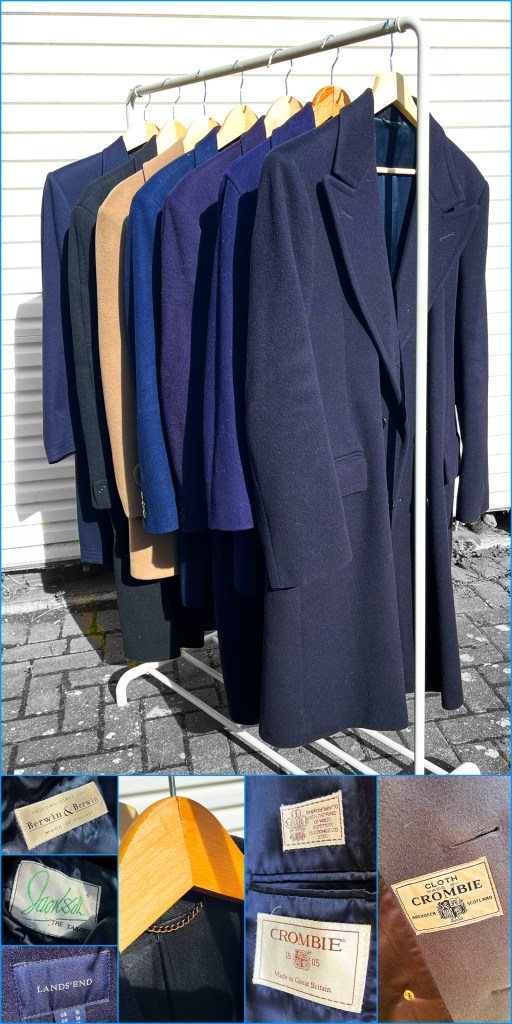
Over the years my love for an overcoat has remained strong. I have added several more to the collection. My favourite is a vintage midnight blue Italian military greatcoat that I picked up from some random charity shop about 20 years ago. Double breasted and quite heavy. It originally featured silver buttons which I replaced with simple black ones. It’s a pleasure to wear in the cold winter months. I also inherited a beautiful black wool overcoat that belonged to my father-in-law. It dates back to the 1950s. He was a great man and I always think of him whenever I wear it. There’s also sturdy Lands End Pea Coat and a couple of Crombies, including a double breasted 1970s mid-length version in camel. I once wore this to watch football in the pub and my friend Geoff amusingly called it a ‘spiv’s coat’. Maybe he had a point.
In the Summer months I keep them in special garment covers neatly hung on a clothes rail. I’m thinking of leaving an instruction in my will for them to be redistributed among the charity shops of Muswell Hill. I love the idea of some future scholars benefitting from my extensive and dearly loved Oxfam Overcoat collection.

Collecting was always a thing when I was growing up. I’m sure I got the bug from my older brother who loved Brooke Bond picture cards back in the 1960s.
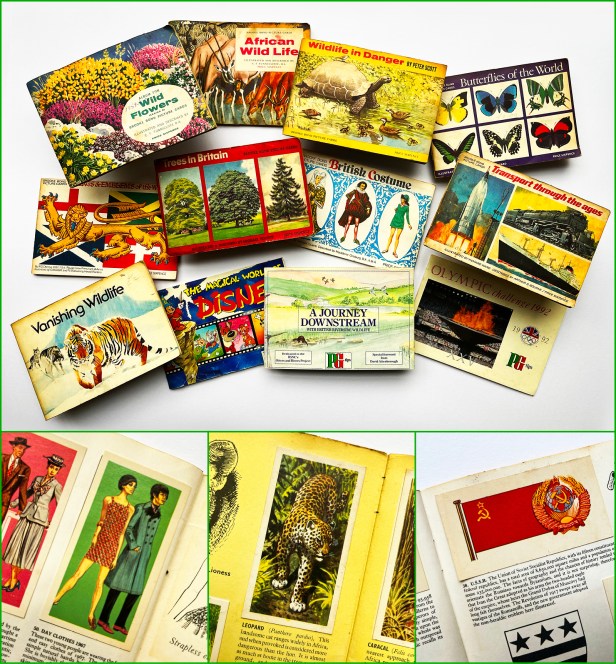
There’s an innocent historical beauty about these collections which were issued by Brooke Bond between 1954 and 1999. There would be one card per packet of tea. Patience was needed to complete each set of 50. There were also albums to stick them in, acquired via Royal Mail and a postal order directly from Brooke Bond HQ.
I picked up some of these older examples from a charity shop many years ago. Others I purchased at the time of their original release in the early 1990s.
Leafing through them now evokes a wistful nostalgia. In what was perhaps a simpler, more innocent age, the broadly educational themes appealed to millions of inquisitive children. Renowned wildlife illustrator Charles Tunnicliffe, also famous for his work on Ladybird books, painted several series.
I’m fairly sure my brother’s original picture card collection is still somewhere in the family home in Liverpool. Probably in the attic. Along with the board games, cricket bats, Beano annuals and other dusty childhood memories.
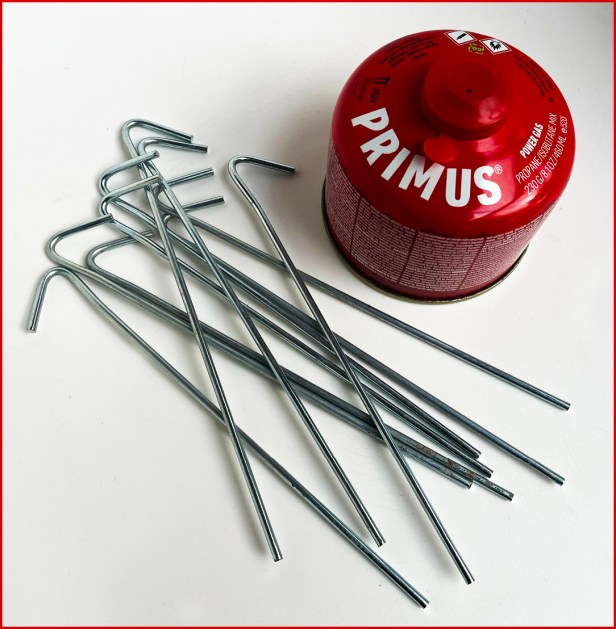

I can state with some certainty that camping does not rate highly in my list of favourite pastimes. Which is not to say I’ve never partaken in this activity at certain points in my life.
When I was around 13 years of age a bunch of us would sometimes camp in the back garden in the Summer. It’s no surprise that these occasions were anarchic, chaotic, hilarious affairs. Often resulting in complaints from neighbours and admonishment from parents.
In the glorious summer of 1981 myself and 3 friends boarded a coach from Liverpool to the south of France. Our destination was a campsite in the charming seaside enclave of Port Grimaud, often referred to as the ‘Venice of Provence. We spent 10 carefree days there. The town’s architectural beauty, gallic glamour and belles plages contributed to a memorable holiday.
A large section of our garage is beginning to resemble a branch of Blacks. There’s an endless array of two-man tents, sleeping bags, rucksacks. wellys, portable stoves and folding chairs. The reason my family have accumulated all this stuff is because we have attended a lot of music festivals in recent years. I was always a festival skeptic. The idea of camping in a muddy field, not having a shower for 5 days and drinking overpriced weak lager from a plastic cup whist listening to some also-ran indie band never appealed to me. How wrong I was. In July 2009 I agreed to attend the Latitude Festival with my youngest daughter. It was an epiphany. Our festival party included a bunch of her friends and their parents. It was the first festival I ever went to and I really enjoyed myself.
More recently I have been to the Green Man Festival in the Brecon Beacons on 4 occasions. Again with the youngest, who is now grown up, more of her friends and their parents who are now my friends. On each occasion I have had a magical time. I grew to love the whole festival process. The anticipation. The preparation. Sorting out what to wear. Daughter and I would get the coach from Victoria directly to the festival site in Wales. Easy and straightforward. We’d arrive on the Thursday afternoon to rendezvous with the rest of the gang who had already claimed our festival base. Having pitched our tents we’d crack a beer and work out what bands we were going to see. I wrote about and photographed one of our visits here. Green Man traditionally hosts a beer festival during the 4 days, which adds an agreeable extra dimension to the whole event.
The youngest has become a festival veteran, having utilised our stock of camping gear a number of times at Glastonbury, which she always seems to miraculously acquire a ticket for.
Upon our return from each festival excursion we stash all our camping gear back in the garage, in readiness to be stumbled over one dark winter night when I’m vainly searching for the Christmas decorations.
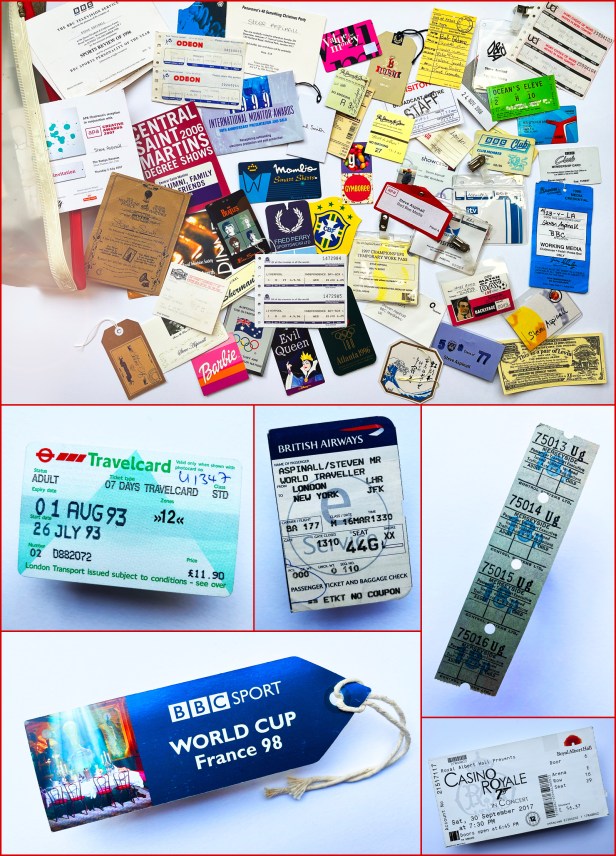

I have always hoarded small format printed matter. Tickets, receipts, invitations, flyers, clothes tags, etc. As a Graphic Designer these tokens of everyday life, their layout, shape and texture, have always intrigued and fascinated me.
Amongst the collection are many tickets from football matches. The ones from cup finals are like old banknotes, finely printed on tasteful stock with subtle watermarks. Gig tickets were often cheaply printed on flimsy coloured paper yet somehow they retain a nostalgic glamour. The pastel colours of the Liverpool bus tickets of my youth bring to mind a daft schoolboy game; if the serial number added up to 21 it meant you were incredibly lucky and should fling the ticket at the girl you secretly fancied to make her yours. It doesn’t even make sense. My most prized ticket is from when I saw Frank Sinatra in concert in 1992. I wrote about it here. It’s now mounted under archival glass and sits proudly on the wall in our hallway.
The printed residue of travel also features heavily. Boarding passes, train tickets, travelcards and more. I have lived in London for over 40 years. Having rode the underground thousands of times I could probably chart the design evolution of the humble tube ticket. It’s fascinating to see how these things change graphically over the years. Finding a restaurant bill from a long ago holiday somehow evokes warm memories of cocktails on some sunlit mediterranean terrace. Or that romantic train journey from Roma to Napoli.
We live in an age where tickets now only exist as digital files. Sent to us via email and stored on our phones. The warm-hearted notion of retaining a physical souvenir from a concert, football match or excursion feels like it has gone forever. With this in mind, a few years ago I started to design a glossy book about the art of the humble ticket. A3 landscape in format, the idea was to reproduce each featured ticket in great detail, one per page with copy written by myself appraising the design and layout etc. I was some way into this task before my enthusiasm waned. Real life probably intervened and the project shelved. Maybe it’s time to bring it to life again and perhaps try and finally secure that book deal.

When I was a young boy, around 7 or 8 years of age, my friends and I would play out for hours on the streets where I grew up. It was a happy, carefree time.
We all loved Action Man. Introduced in the UK in 1966, it was a posable action figure marketed at boys. A doll, no less. In the days when toys were fairly gender-specific, he (always a he) came dressed in Army fatigues and armed with a gun or a rifle. Playing ‘war’ was quite commonplace. It was a time when the 1939-45 conflict was within most adults living memory. War films were popular. Children’s comics were full of heroic wartime adventure stories. For most boys, the Action Man soldier was the toy to have. Other variations became available; including pilot, parachutist and deep sea diver. We’d play with ours all day, using the mid-century architectural landscape of the Childwall Valley Estate as our battlefield.
My own personal Action Man was not the authentic Palitoy branded model that my friends owned. Mine was a cut-price copy, more flimsy and easily broken – probably bought by my Mother from the market. Even at a young age I think I sensed that times could be hard and some things were expensive. My friends teased me about my cheap version but it didn’t bother me. I understood. Some kids never had a proper holiday but we went away every Summer. I accepted that, as part of a large family, I couldn’t have everything.
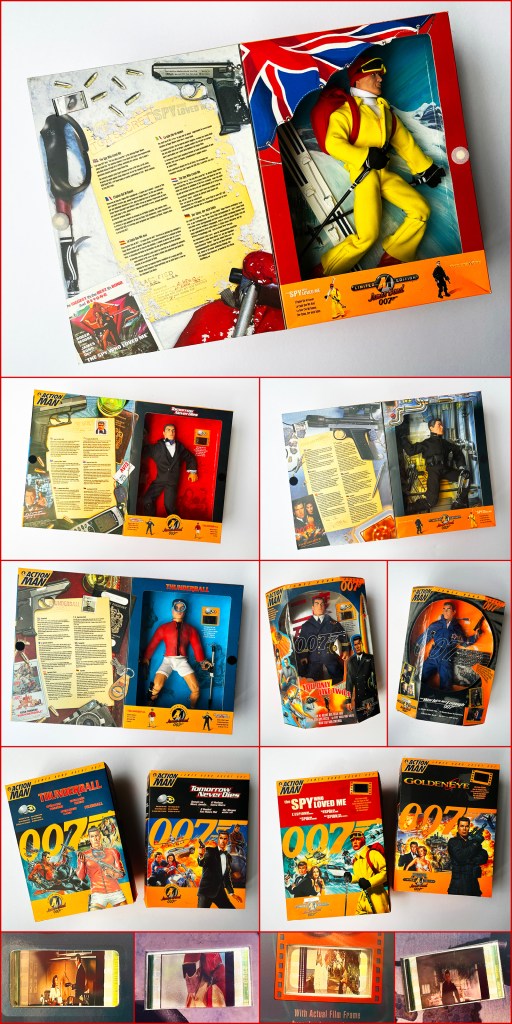
Flash forward to 1997. My wife and I sold our one bedroomed flat in North London. The idea was to trade up to a bigger place. The situation was complicated by the imminent birth of our second child. As a temporary measure we rented a nice house in Liverpool. I was still working in London during the week, lodging with my wife’s sister, who had a spare room in her houseshare, then heading back up north to my young family at the weekend. My sister-in-law happened to work as a Designer for Hasbro who had just relaunched the Action Man brand, moving it away from a military theme and towards a more modern ‘adventure’ approach. She knew I was a James Bond fanatic and informed me that the company had developed an Action Man 007 series. My birthday and Christmas presents were secured for the next couple of years.
The limited edition 007 Action Man range are beautifully put together. Six in all, each one based on a different Bond film. The atttention to detail is lovely. I have kept them in their original packaging, some of which, amazingly, include an original 35mm anamorphic film frame. I still get a joyous buzz every time I take them down and look at them.
My 7-year-old self would be thrilled to know that in the future he would be the proud owner of not just one but six authentic Action Man figures. The added bonus of them all being James Bond would probably have made him cry with happiness.
Perhaps good things really do come to those who wait.

You never forget your first visit to New York.
As mentioned earlier, I attended art school from 1983 to 1987, completing a year’s Foundation Course at Liverpool Polytechnic then studying for my bachelors degree at Central Saint Martins in London. It was an exciting and memorable 4 years that shaped my life in many ways. During my graduation year I was fortunate enough to win a Royal Society of Arts Design award, a nationwide competition for final year design students.
The RSA’s brief required students to produce packaging for a museum. I created designs for a range of products for the Imperial War Museum having been inspired by a recent visit there. These included Army biscuits, an Army mug, Royal Navy toffees, RAF Boiled Sweets, a model RAF Spitfire and a branded carrier bag. (More in this post from a few years ago.)
The RSA award came in the form of a bursary, financing an educational trip abroad. I chose New York. Its widescreen glamour had always fascinated me. As a keen aficionado of editorial Design my idea was to interview the Art Directors from my favourite American publications, including Rolling Stone, Esquire and GQ – none of which, at the time, had yet to publish a UK version. Part of the brief was to create a report about my experience, to be delivered to the RSA upon my return.
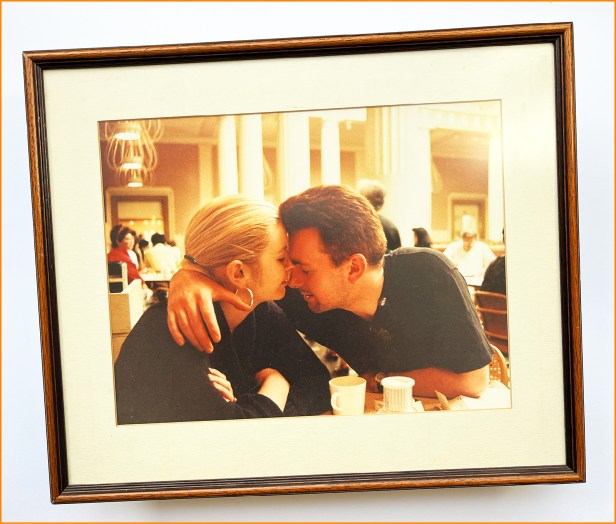
This photograph is of me and my then girlfriend who was in the year below me at college. In a twist of serendipity she, in partnership with a fellow student, also won the award the year after. We decided it would be fun to travel together and flew to New York in September 1988.
Landing late in the evening, it was nearing midnight when we checked into our hotel on the West side. At that time parts of Manhattan still had an edge. Wallking down a bustling 57th Street at midnight felt exciting and mildly dangerous.
The trip was full of wonder and excitement. As well as taking in the city’s magnificent sights, I got to fulfil my schedule of Art Director visits. The staff at Rolling Stone were extremely cool. I spoke at length to the magazine’s lovely Design team who were very helpful. The Art Director of GQ was a bit less cordial. I didn’t mind. It still felt like a privilege to take the lift to the upper floors of the super-glamourous Condé Nast HQ, also home to Vogue, on Madison Avenue.
A highlight was meeting Rip Georges, renowned Designer who was then Design Director of Esquire. I had been a long standing admirer of that publication. It had a great tradition of brilliant editorial design ever since it’s first issue in 1933. Rip was a genial host, treating myself and his team to lunch at a Broadway diner. I felt like I was living in a Hollywood movie.
Exploring late-Summer Manhattan was romantic and inspiring. I have a particularly wistful memory of us walking through it’s vast canyons of steel during an afternoon downpour. Skyscrapers lost in a mist of fine rain. Wonderful and atmospheric. The deli’s, the bars, the enormous breakfasts. The Empire State Building. Broadway. Little Italy, mysterious and interesting. Like a real-life Scorsese movie set.
Visits to New York’s great cultural institutions were also scheduled. Including the magnifcent Museum of Modern Art and, of course, The Met with it’s treasure-trove of fine art and in whose cafe this photograph was taken. I had forgotten about this picture but I’m so glad it’s been rediscovered. I love it. I love the film grain. I love the light. The warm tones. A candid moment captured. Every time I gaze upon it my mind wanders back to that wonderful week in September 1988.
You never forget your first visit to New York.
Postscript
The girlfriend became my wife in 1990. We’re still together and life has been kind. Her fellow student winner was and still is our lovely friend Elise, who also shot this beautiful photograph on that memorable afternoon at The Met.

No AI was used in the making of this blog post.
 The Steven Aspinall Archive
Oh wow I remember those Thunderbirds toys. We had the island here too with soundeffects.
Pleased you appreciated that, Frederic!
Great stuff ste brilliant job.
Cheers Phil – glad you enjoyed it.