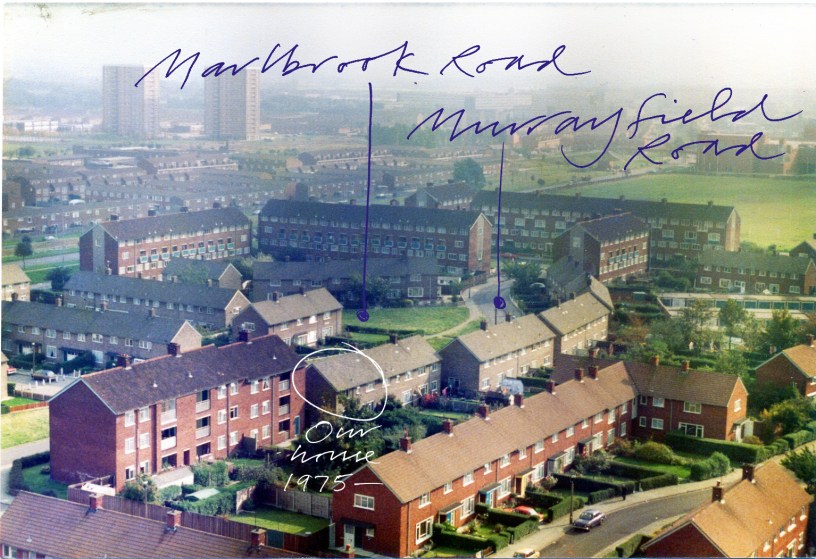
Although I have lived in London for two thirds of my life I still feel very much a product of where I spent the first 23 years of it. The Childwall Valley Estate shaped me, gave me my values and made me the person that I am today. I shot these photographs in 1979 when I was 18. I have been contemplating an essay about them for some years but every time I sat down to write it I just couldn’t think of an appropriate way in.
I wanted to avoid constructing something formulaic or cliched about growing up on a council estate. My aim is to convey the affection I feel when I reflect upon those 23 years – a positive memoir rather than a pretentious critique.
At first glance, these images perhaps suggest that the area was dour and oppressive. The reality was different. It was vibrant, interesting and populated with fascinating characters and stories.

It starts in the 1940s. Over one thousand prefabricated houses, known as prefabs, were built in this area of south Liverpool between 1945 and 1947. Affordable rented accommodation for people whose homes were destroyed in bombing raids on the city during the Second World War. The more permanent Childwall Valley Estate began construction in 1957. That same year a 15-year-old schoolboy named Paul became friends with a 16-year-old art student called John after meeting at nearby Woolton village fete.
Our estate was a classic post-war council housing development. A basic confection of modern houses with gardens front and back and pockets of green space in every street. Eventually the prefabs would be torn down and low-rise flats and tower blocks added to the architectural mix.
Often referred to as the Hartsbourne Estate, Belle Vale and Childwall Valley sit just north of Woolton, five miles from Liverpool City Centre. My mother liked to think we lived in Woolton, although sometimes she’d say we lived in Gateacre. Both areas were deemed ‘posh’ to her. This naming convention was extremely confusing to my younger self. The truth was that we lived on the Childwall Valley Estate as demarcated by an enormous sign typeset in a bold mid-century font atop a vast wall at the corner of Chislehurst Avenue and Childwall Valley Road.
My parents were one of the earliest families to take up residence on the estate and were the first inhabitants of Marlbrook Road when they moved there with my older brother and sister in 1958. They had previously lived where they were born and raised, in the densely-populated cobbled streets of Kensington on the outskirts of Liverpool City Centre. Mum said that Childwall Valley felt like it was miles from anywhere; ‘It was like moving to the countryside.’
I arrived in 1961. When I think back to my 1960s childhood, a stream of brightly coloured memories flicker like reels of super 8 projected in my mind; the vivid red carnations in our front garden, Liverpool winning the cup, dressing up for Halloween, coach trips to Blackpool, the 79 bus to The Abbey Cinema, my older brother buying Penny Lane, Bonfire Night parties, caravan holidays in Wales, summer blackberry picking in the empty fields where the pre-fabs once stood…
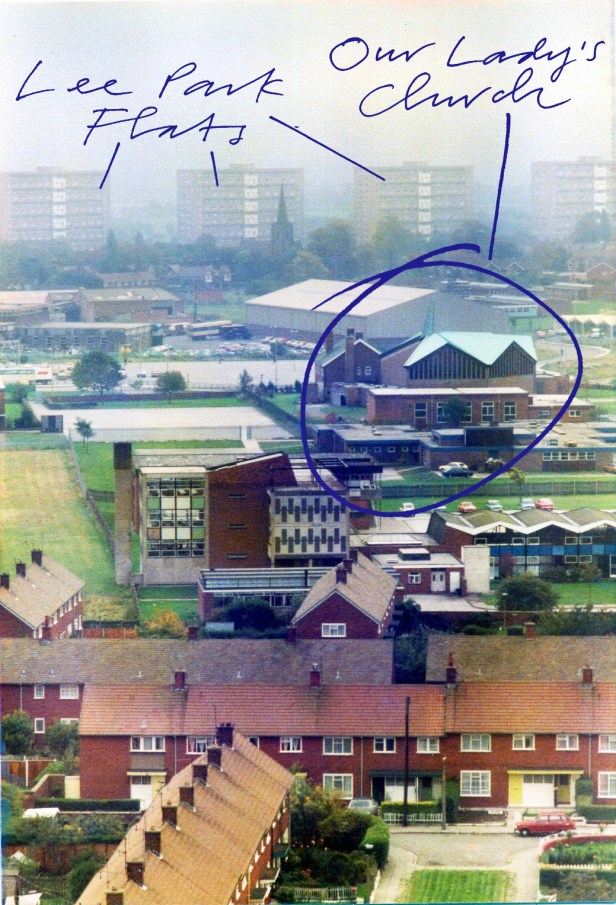
It was a close-knit community; I can still recite the names of all the families who lived in our road. Everyone seemed to have lots of children who all played in the street and walked to Craighurst County Primary School together. Unheard of now. We always felt safe. There was, of course, far less traffic around in those days. In the holidays we’d play football on the field of the local Catholic School, Our Lady of The Assumption – Our Lady’s – overlooked by its striking mid-century modernist parish church, built in 1967.
Being introduced to the public library on Hedgefield Road was a significant moment for me. I loved spending time there, losing myself in their children’s section. I now reaslise my affectionate reminiscing makes it sound like I grew up in Narnia or some Blytonesque fairytale dell. A view which, on face value, these photographs perhaps contradict. The fact is that children do not judge, they have no pre-conceived ideas about class or culture and generally respond positively to warmth and kindness. My little world was filled plenty of both in that decade.
The 1970s ushered in a more realistic age with maybe a little less lustre in my mind’s picture show. The colour is graded in muted hues rather than Technicolour primaries. It’s a still a family movie, but with perhaps a touch of kitchen-sink drama.
I began my secondary education at Gateacre Comprehensive School – The Comp – in 1972. It sat, like Sauron in Mordor, at the top of Grangemeadow Road overlooking the whole estate. We could never escape it’s all seeing eye. A few of us also started hanging out at Childwall Boys Club – The Boysie – on Lyndene Road where we played for their football team.
Around 1970 the shops and the library on Hedgefield Road were demolished and work began on a modern new red brick shopping centre – The Shoppy – which opened to great fanfare in 1973. The retail spaces inside provided work for many local residents. I always loved its non-more-70s logo, a stylised lower case ‘bvc’ in green white and blue.
By this time, a sprawling new estate of houses and flats had sprung up further down Childwall Valley Road in the area known as Netherley. Nearer to us, where once had stood prefabs and where lush blackberry bushes had grown in abundance, a more brutal looking set of narrow houses and box-like flats were built. Among these new buildings was placed a brand new pub, The Highwayman, which opened in 1975.
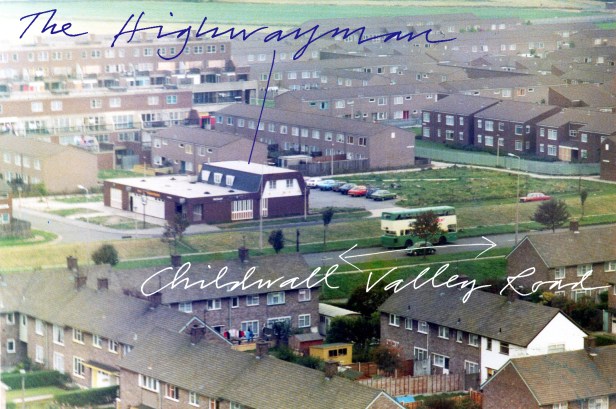
In 1974 my maternal grandmother passed away and my grandfather came to live with us. He was 73. (I have previously written about his fascinating life here and here.) Consequently there was a space problem in our little three bedroomed home and in January 1975 we moved 200 yards round the corner to a four bedroomed dwelling on Murrayfield Road. Same estate, different house.
A short walk from our new home, along Hartsbourne Avenue, stood the Community Centre – The Commy – where I went to both judo and painting classes. At the top of Murrayfield stood The Salvation Army building – The Sally – where I’d once attended Sunday School and the location of my early and somewhat intimidating experiences of teenage discos.

Further down Childwall Valley Road stood Woolton Ward Labour Club where The Quarrymen once played and where my father was Concert Secretary. I collected glasses there aged 15 and, when I was slightly older, worked behind the bar for a time. All human life passed through that place. It was an entertaining experience and a steep learning curve.
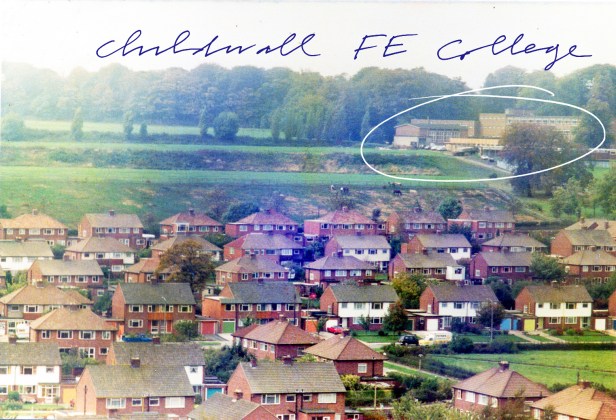
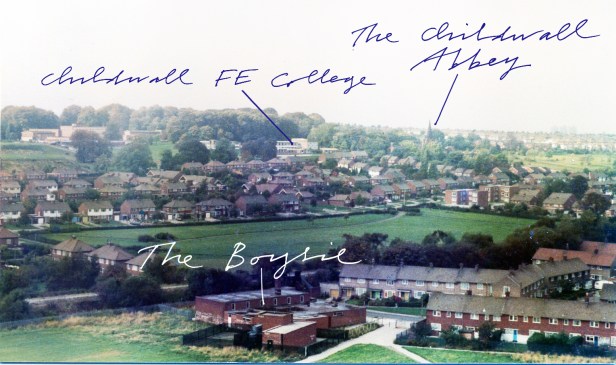

Beyond the estate, up the hill into the private housing enclave of old Childwall was The Childwall Abbey public house. I consumed my first legal pint in here in the same year these pictures were taken. I’ve probably drank in the Abbey more often than any other pub. Beatles fans may note that John, Paul and George played here as a trio at George’s brother’s wedding in 1958. It stands next to All Saints the only medieval church left in Liverpool, parts of which date back to 1716. Just across the road was Childwall Further Education College. I briefly attended here as a 19 year old student.

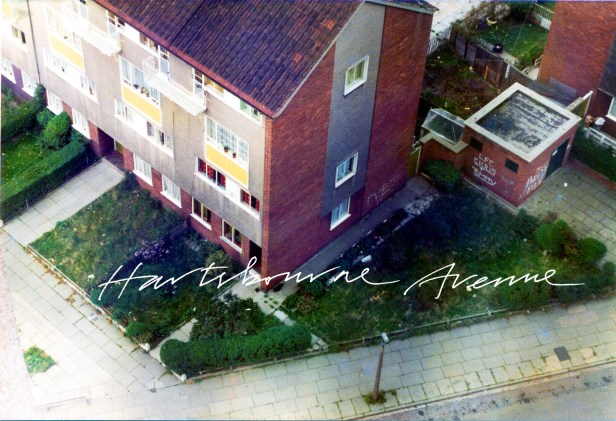
The estate was bordered by a host of residential tower blocks standing like monoliths at the edge of some ancient civilisation. There was Childwall Heights and Hartsbourne Heights at the end of Hartsbourne Avenue, The Lee Park Flats which were all named after UK Prime Ministers, and further down towards Netherley, The Hawthorns. In the middle of The Estate, as if to pinpoint its epicentre, stood a solitary tower known as Valley Views. The flats within offered just that. On a clear day you could see for miles. One September morning in 1979 I took the lift to the top floor and shot these photographs. The lens of my Zenit E pressed against the metal safety grille on the dusty windows.
Postscript
I left The Estate for London and Art School in 1984. I return often. So much has changed in those 40 years.
The Valley Views and all the other imposing tower blocks have long been pulled down. As have all the other low-rise flats. In their place are tidy rows of new-build, semi-detached houses with big gardens and car-parking spaces. The Highwayman is but a memory and on the site of Woolton Labour Club is the magnificent Millenium Centre doing wonderful things for the community.
The site and buildings of Childwall FE College eventually became Mersey Television and, later, Lime Pictures. I worked there from 2009 to 2011.
I still occasionally drink in The Abbey, often with the same bunch of friends that I drank with in 1978. The family home is still in Murrayfield Road, but my younger brother is the sole occupant now. I still have a bedroom there. Some things never change.
I often think about one day taking the short walk from Murrayfield to the spot where the Valley Views stood and sending a drone up to recreate these photographs – something that 18-year-old me would probably have thought was science fiction. Maybe I will one day.
 The Steven Aspinall Archive
Wonderful reminiscences of a time before now… happy I could share some of those times, places, experiences in our childhood years. I can still hear that crazy yard dog behind the fence next to Charlie’s van. As a paper boy, dogs were the thing I feared most. Funny thing, though… growing up on a council estate in Liverpool, I never once encountered drugs, users, or pushers. Perhaps I was lucky, or perhaps our estate was graced in some way.
Thanks mate! Charlie’s Van! What character he was… It always felt safe – and it still does whenever I go back to stay with our Peter.
Thankyou Steve – my dad Charlie 🤗
Nice one, Pat! I remember him well. x
cheers Steve – my dad Charlie 🤗
I really enjoyed reading and reminiscing a short period of my child hood. Lived in Lee Park 73-80 went to Gateacre Comp from 1974-81 (moved but stayed at the school) my best friend lived just round the corner from you.
All the neighbours were neighbourly! Many called auntie ….but no relation! I really get what you mean about fondness of the area. Lots of good memories. Thank you
Thanks so much for the kind feedback, Donella. I’m really pleased that you enjoyed reading it.
A brilliant piece of history I grew up in Netherley. I have added your story link to my facebook group. LOVE LIVERPOOL HISTORY.
Thanks for the memories.
Brian
Thank you, Brian. I’m so glad you enjoyed reading it.